The Greene as a Destroyer was primarily an anti-submarine weapon. A sub killer. It's even part of the ship's insignia. I really struggled with that Latin phrase, it seems to be saying: 'State and Clears Prepared'. Really? What does that have to do with laxatives?
 On the ship's patch is an English phrase: On the Affirmative Way'. Hmm? I think I like 'State and Clears Prepared' better.
Well, choose whichever phrase you'd like. At least the dice make sense. There was also a tradition to blast a song whenever we pulled up alongside another vessel. The song was 'Green, Green' by the New Christy Minstrels. If you're bored you can listen to it here.
https://www.youtube.com/watch?v=PfxgbsXeTdE
On the ship's patch is an English phrase: On the Affirmative Way'. Hmm? I think I like 'State and Clears Prepared' better.
Well, choose whichever phrase you'd like. At least the dice make sense. There was also a tradition to blast a song whenever we pulled up alongside another vessel. The song was 'Green, Green' by the New Christy Minstrels. If you're bored you can listen to it here.
https://www.youtube.com/watch?v=PfxgbsXeTdE
I always loved that the lyrics include "Say, buddy, can you spare me a dime?" Because, you know, we're homeless and we're worthless and we have no money. It really lifted my spirits.
At this point, I was sending a lot of my paycheck home because I was still making the car payments on the car I had given to my father. It was his first relatively new car since I had bought it less than a year before. The money was going home via money order, ever heard of them? People without a checking account (like my parents) had to pay their bills in person or buy a money order at 7-11 for the amount plus fifty or seventy-five cents and then mail in the money order. My parents refused to get a checking account because they said it would cost too much. ... ... Yeah, I know, I tried, but they never got a checking account.
 But even sending that car payment home I always seemed to have more money than everyone else and they were always running out like the day after payday. So I developed a pretty lucrative loansharking business. Calm down, I never overcharged and I only loaned money to my friends so I never had to break anyone's legs. In retrospect, I was only providing a service based on a clearly defined consumer need. That's what I tell myself anyway.
The base where we were doing our refit was as big as a small town. There was every kind of mechanical shop you can image along with human niceties like bowling alleys and restaurants and a huge gym which I used all the time.
But even sending that car payment home I always seemed to have more money than everyone else and they were always running out like the day after payday. So I developed a pretty lucrative loansharking business. Calm down, I never overcharged and I only loaned money to my friends so I never had to break anyone's legs. In retrospect, I was only providing a service based on a clearly defined consumer need. That's what I tell myself anyway.
The base where we were doing our refit was as big as a small town. There was every kind of mechanical shop you can image along with human niceties like bowling alleys and restaurants and a huge gym which I used all the time.
But after working all day, sometimes you wanted to get those grimy clothes off, wash the paint chips away and go have a drink. In this illegally taken photo, someone kindly captured the essence of Rich the sailor-boy standing with my friend Owens who had no first name. Look how happy and filthy I am! I was probably going to be leaving the ship soon.
But no one wanted to go into town in uniform. You were treated much better if you were in civilian clothes. Some businesses had signs posted that read 'No Dogs or Sailors Allowed'. However, when you left the ship, you had to be in uniform and that created a conundrum.
This collision of worlds was solved by entrepreneurs who developed a system of locker rooms which they built right outside the base gates. You could rent a locker and keep your civilian clothes off base and change and shower right there.
Many of them also ran a bar, a tailor and a laundry so when you came back at the end of the evening, you gave them your disgusting, sometimes bloody clothes and they would be ready for you next time around.
This was the true essence of capitalism, the creation of a service based on a clearly defined consumer need. Even if the consumers were sailors.
 There were always watches to be held aboard ship. Since the Greene was now deep inside a Naval Base, watches were mostly to keep an eye out for fire. But we did have some advanced weaponry on board. Beside the cannons and anti-aircraft guns, the torpedoes and depth charges, there were cruise missiles and DASH - a Drone Anti-Submarine Helicopter.
The DASH was pretty cool considering this was all happening more than fifty years ago. So the watches were at least to some degree security minded what with the tactical nuclear devices and all.
Watches were kept 24 hours a day, usually four hours long with the worst being the dreaded 'midwatch' which ran from midnight to 4 AM. The mess always had coffee going and would cook up some chicken noodle soup for the midwatch people so they wouldn't pass out and fall overboard.
I was a little surprised to discover that while in port the concept of 'weekends' existed. I just thought they would work us like rented mules except for rare instances of liberty. But even during the rehab of drydock, if we didn't have duty, we were usually granted liberty. Let me be clear, if we could get off the ship, we got off the ship. Since the drinking age was 18, there were all the bars in the world to choose from.
There were always watches to be held aboard ship. Since the Greene was now deep inside a Naval Base, watches were mostly to keep an eye out for fire. But we did have some advanced weaponry on board. Beside the cannons and anti-aircraft guns, the torpedoes and depth charges, there were cruise missiles and DASH - a Drone Anti-Submarine Helicopter.
The DASH was pretty cool considering this was all happening more than fifty years ago. So the watches were at least to some degree security minded what with the tactical nuclear devices and all.
Watches were kept 24 hours a day, usually four hours long with the worst being the dreaded 'midwatch' which ran from midnight to 4 AM. The mess always had coffee going and would cook up some chicken noodle soup for the midwatch people so they wouldn't pass out and fall overboard.
I was a little surprised to discover that while in port the concept of 'weekends' existed. I just thought they would work us like rented mules except for rare instances of liberty. But even during the rehab of drydock, if we didn't have duty, we were usually granted liberty. Let me be clear, if we could get off the ship, we got off the ship. Since the drinking age was 18, there were all the bars in the world to choose from.
Along the main drag of Norfolk were bars, cheap restaurants, a couple movie theaters, and at the end of the street, the Douglas MacArthur Memorial. Speaking of movies, this one time I went to town early intending to meet up with my friends at some bar or other. But mid-day, I went to see 'Casino Royale' with Peter Sellers.
In those days, there was something called 'continuous showings'. When the feature ended, the theater went right into the previews and then the feature started again with no 'lights up' time in between. So I sat there and watched that movie over and over until the theater closed. I've never done anything like that before or since. No other movie ever deserved it.
Even though it was very uneven and had maybe five different directors, Casino Royale was hysterical then and I still watch it whenever it comes on TV. Why, I could watch it again right now!
 Practically everyone on the ship smoked and they all made fun of me for not smoking. But even then I just told them I was rebelling against my parents by not smoking. This always amused me. The phrase 'The smoking lamp is now lit' meant nothing for me!
Our days were spent around paint. Paint, paint, paint. Taking paint off and putting it on. Taking it off and putting it on. First red lead, the primer and then some shade of grey. But first we had to take the old, tired paint off. To do that trick, the first tool we used was the pneumatic needlegun which shoots metal rods in a repetitive pattern out of the end of the device with the side effect of loosening your teeth.
 Only on infrequent occasions would one of the needles disconnect from their little cage and shoot someone in the leg. The slamming action it performed would burst any loose paint off the surface and into your eyes and mouth where it evidently belonged. The person in this photo is wearing eye protection. Hah! Not in 1967, such an innovation had not been invented.
The other main device was the pneumatic disk sander. The thing would sand the remaining paint off in a dust cloud that would enter your lungs and stay there killing you. The trouble with this monster was that after using it for ten hours, it seemed to actually get heavier. And when you're the tall guy who can reach much higher than other people, most of your sanding is done over your head where it got even heavier.
 Sure enough, I brought it down one time right onto my knee. CHING! Cut a huge groove in my kneecap. You might not think there was that much blood in the kneecap area... but there is! Enough to run down your leg and fill up your boot so that as you walked to sick bay, you would leave bloody footprints behind you. And of course, your shipmates are yelling at you because now they're going to have to mop up all that blood and that was inconveniencing them.
Yes, the scar is still there and the groove is still in my kneecap and I still hate my friends. Good times.
Sure enough, I brought it down one time right onto my knee. CHING! Cut a huge groove in my kneecap. You might not think there was that much blood in the kneecap area... but there is! Enough to run down your leg and fill up your boot so that as you walked to sick bay, you would leave bloody footprints behind you. And of course, your shipmates are yelling at you because now they're going to have to mop up all that blood and that was inconveniencing them.
Yes, the scar is still there and the groove is still in my kneecap and I still hate my friends. Good times.
Eating was a major event, it was that 'change of pace' that broke up the day and we ate like kings. The food in the Navy was always top-notch. There were steaks and crab cakes and the first time I ever had lobster tails was on board the Greene. But the enlisted mess deck only held maybe 40 or 50 men so there was no dawdling over brandy and cigars. You got in, you got out and sometimes you had to take your food elsewhere. Once in while they would have a cookout on the fantail and on Sundays they would serve brunch all morning in case someone could sleep.
This photo above is an actual photo in the galley of the Greene and this man from the Philippines is about five feet tall. Now picture me at six foot four hunched over like a vulture. I always dreaded mess duty, it took me another week to recover my ability to stand.
 The morning opened with reveille and these orders: "Sweepers, Sweepers, man your brooms. Give the ship a good clean sweep
down both fore and aft! Sweep down all decks, ladders and passageways!
Dump all garbage clear of the fantail! Sweepers." The ocean is still clogged with all the brooms thrown overboard because as soon as we could, they were tossed and we went down for breakfast.
You may notice that the normal daily uniform was just jeans and a blue work shirt. You only wore your dress uniform on board for arriving and departing port. And these were 'working' dress uniforms, we would never wear them for liberty... heavens!
And, yes, all our uniform pants had bell bottoms. No, not for style or tradition but because large bell bottomed pant legs could be quickly and easily folded up when the deck was awash.
The morning opened with reveille and these orders: "Sweepers, Sweepers, man your brooms. Give the ship a good clean sweep
down both fore and aft! Sweep down all decks, ladders and passageways!
Dump all garbage clear of the fantail! Sweepers." The ocean is still clogged with all the brooms thrown overboard because as soon as we could, they were tossed and we went down for breakfast.
You may notice that the normal daily uniform was just jeans and a blue work shirt. You only wore your dress uniform on board for arriving and departing port. And these were 'working' dress uniforms, we would never wear them for liberty... heavens!
And, yes, all our uniform pants had bell bottoms. No, not for style or tradition but because large bell bottomed pant legs could be quickly and easily folded up when the deck was awash.
Fun on board the ship took two forms: leaving the ship as soon and often as we could and fighting. There was no TV and the ship's library was a single shelf of books maybe three feet long. The nightly diversion was a movie shown in the crew's mess. Since it's more difficult than you might think to fit 250 men into a space that accommodates no more than 50, disagreements arose and were rarely settled via negotiation and compromise.

Since we all carried large knives which were required for our jobs, it is amazing we had the discipline not to carve one another up like Thanksgiving turkeys. But the fist fights and food fights would put any fraternity to shame. It's interesting to note that when you see people punching one another in movies, they may show teeth getting knocked out, but they never explain that teeth are hard and sharp and can take chunks out of your knuckles. and when those chunks are right on the bendy parts of your fingers, it can take weeks to finally heal. {The more you know!}
Our first actual cruise took us from Norfolk to Portsmouth, Virginia. That sounds cool, but it was only a couple of miles around the harbor. Because the Greene was going into drydock and the level of paint chipping and scraping and sanding and painting was about to reach monumental proportions.
But, be that as it may, I had now been on an actual warship underway under it's own steam. It was really very interesting to feel the rumble of the big engines. Because who knows what might happen next!
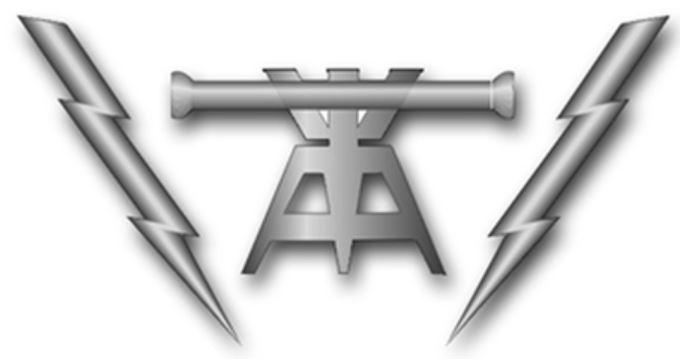
 Coming out of boot camp, I had been targeted with the rating (job function) named Fire Control. Before you get all excited and think, OOOooo, a fireman!... No. No. 'Fire Control' in this instance means the technicians who handle the computers that target, aim and fire the ship's weapons. This symbol is for the Fire Control rating. So, long before I ended up at Eastern Airlines at their computer division, the Navy had somehow figured out my facility for computer-work even at this early stage. I guess all those tests we were taking weren't just for fun.
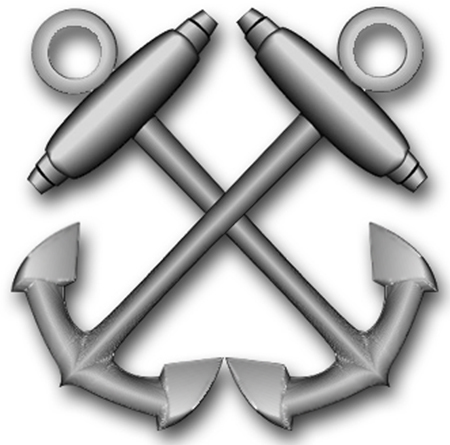
But you don't get to be president of the company without having to do some work first (usually), so all the new kids went into First Division. Here were the actual sailors who did sailor-stuff on the ship, steering the boat, loading stores, chipping paint, you know... sailor-stuff. The people who worked permanently in First Division came under the rating Boatswain's Mate, pronounced Bosun's Mate. This symbol is for the Boatswain's Mate rating. Look, they're anchors!
Coming out of boot camp, I had been targeted with the rating (job function) named Fire Control. Before you get all excited and think, OOOooo, a fireman!... No. No. 'Fire Control' in this instance means the technicians who handle the computers that target, aim and fire the ship's weapons. This symbol is for the Fire Control rating. So, long before I ended up at Eastern Airlines at their computer division, the Navy had somehow figured out my facility for computer-work even at this early stage. I guess all those tests we were taking weren't just for fun.
But you don't get to be president of the company without having to do some work first (usually), so all the new kids went into First Division. Here were the actual sailors who did sailor-stuff on the ship, steering the boat, loading stores, chipping paint, you know... sailor-stuff. The people who worked permanently in First Division came under the rating Boatswain's Mate, pronounced Bosun's Mate. This symbol is for the Boatswain's Mate rating. Look, they're anchors!
 My immediate superior was a Boatswain's Mate Petty Office Second Class named Lennox. I should have already pointed out that no one I encountered in the Navy ever used a first name, so I have no idea what his first name was or even if he had one. But he was responsible for my performance ratings which were always high and had pivoted on one event early on.
Often, people would take the attitude, "If you're not watching me, then you don't care and I'm not working." But BM2 Lennox had taken me high into the mainmast rigging where I had to work alone scraping and painting some equipment. There was only room for one person to hang on so he left and when he came back I was just finishing up what had been a considerable amount of work. I think he was so surprised, he nearly fell to his death.
After that, he knew he could trust me to do work unsupervised, which freed him up to drink more coffee and this pleased him. Coffee was available 24 hours a day and many of the career men were never seen without a coffee cup on their finger. Even when they were sleeping or showering.
My immediate superior was a Boatswain's Mate Petty Office Second Class named Lennox. I should have already pointed out that no one I encountered in the Navy ever used a first name, so I have no idea what his first name was or even if he had one. But he was responsible for my performance ratings which were always high and had pivoted on one event early on.
Often, people would take the attitude, "If you're not watching me, then you don't care and I'm not working." But BM2 Lennox had taken me high into the mainmast rigging where I had to work alone scraping and painting some equipment. There was only room for one person to hang on so he left and when he came back I was just finishing up what had been a considerable amount of work. I think he was so surprised, he nearly fell to his death.
After that, he knew he could trust me to do work unsupervised, which freed him up to drink more coffee and this pleased him. Coffee was available 24 hours a day and many of the career men were never seen without a coffee cup on their finger. Even when they were sleeping or showering.
 The sleeping area for First Division was arguably the harshest on board. But at least air conditioning had been added before the ship had gone off to Vietnam. Our racks were located at the very front of the ship under the forecastle which is pronounced 'FO'ksul'. This is the part of a ship that rises and falls the most when driving through seas. It was right under that forward 5 inch 38 caliber cannon destined to become my cannon. Compare sleeping there versus the stern section nearest the fantail which remains calmer and flatter even at high speed. Yeah, well, if you want the whole experience, then have the whole experience!
Our living/sleeping/studying/entertainment/recreation area was one thin rack in a stack of three with a thin mattress and one locker just big enough for our clothes. The lockers were built-in to fit the shape of the ship so no two were the same size or shape. When someone left the ship for a new assignment, imagine what happened when he emptied his locker! Of course, I could only fit in my rack sideways or with my knees bent. Oh, and if you wanted to stand up straight and you were my height, well, good luck, buddy!
Only once while I was on board did we haul those mattresses up topside to beat them with sticks and give them a little sun to air out. But this was a real, working Navy ship with a job to do and responsibilities to perform. The Greene had been part of the Cuban Missile Blockade, capsule recovery for both the Mercury and Gemini space programs and had been around and around the world. It's a thing.
Look where I was at the very top of that mainmast above the bridge and I didn't fall off and get killed or anything!
 When I left my Boot Camp barracks, I had no idea I would never be able to return. Not that I wouldn't return, I couldn't return.The recruit buildings are gone. Gone right down to the ground and nothing built where they were. Just grass. Other buildings are still standing on the base after 150 years, but these brand new, modern, concrete structures are gone. Was it because of me? Was it so fouled by my presence that the whole building I was in and the dozens like it all had to go? Who made this decision? Geez.
But pondering a return to Great Lakes was not on my priority list as I reported to the Eugene A. Greene on December 17, 1966. This trip was a little different from reporting to boot camp. This time, I was completely on my own. Yes, there were going to be a couple of guys from my recruit company, but I hardly knew them. However, I was probably not the first kid to go through this, so... tough it out, dude.
When I left my Boot Camp barracks, I had no idea I would never be able to return. Not that I wouldn't return, I couldn't return.The recruit buildings are gone. Gone right down to the ground and nothing built where they were. Just grass. Other buildings are still standing on the base after 150 years, but these brand new, modern, concrete structures are gone. Was it because of me? Was it so fouled by my presence that the whole building I was in and the dozens like it all had to go? Who made this decision? Geez.
But pondering a return to Great Lakes was not on my priority list as I reported to the Eugene A. Greene on December 17, 1966. This trip was a little different from reporting to boot camp. This time, I was completely on my own. Yes, there were going to be a couple of guys from my recruit company, but I hardly knew them. However, I was probably not the first kid to go through this, so... tough it out, dude.
 Norfolk, Virginia is a huge Navy town and there was a whole area designated just for Destroyers. My ship had come in (get it?) so I made my way to Tin Can Alley. The euphemism for a Destroyer is 'Tin Can' or just 'Can' because it is a relatively lightly armored, relatively small and very fast little boat that can actually feel the sea. The bigger warships are more like ocean liners that can smooth out the waves, but compared to them a Destroyer bounces on the ocean like a tin can.
 The Eugene A. Greene was named for... wait for it... Eugene A. Greene! He was a Navy pilot who was killed in action in 1942 during the Battle of Midway. The Navy has a naming convention for their classes of ships and it was decided long ago to name Destroyers after Naval leaders and heroes. His wife actually christened the ship when it was launched in 1945.
So the E. A. Greene was already 21 years old when I arrived on board. That was the very day it had arrived from a really long deployment to Vietnam. That's why so many new sailors were coming aboard and we had to jump out of the way of those leaving, many whose enlistments were up. They would have pushed us right off the gangplank.
This photo below was taken the year I joined the ship so that's very much how it looked.
The specifications for this class of Destroyer call for a ship's crew of 336 officers and men. That's right, no women at that point. With that many men jammed on a World War II era boat, I don't know where they would have stayed anyway. Neither the sleeping areas nor bathrooms were fitted for 'privacy'. There was no such thing. Look at the size of her! Even after a major refitting where missiles and other armament were added and the crew reduced to 14 officers and 260 enlisted men, that was 274 people who lived, worked, ate and slept with nowhere else to go. You were never alone.
 Destroyers don't get individual moorings next to a pier. They are usually stacked outward, so you may have to walk through multiple ships to get to yours. Each time you board and depart a ship, you salute the ensign (flag) at the stern (back end) of the ship and then the Officer of the Day (OOD). So if you're on the third ship moored out from the pier, you have some saluting to do, pal.
When I came aboard, I presented my orders and was instructed that I had been assigned to First Division.
Destroyers don't get individual moorings next to a pier. They are usually stacked outward, so you may have to walk through multiple ships to get to yours. Each time you board and depart a ship, you salute the ensign (flag) at the stern (back end) of the ship and then the Officer of the Day (OOD). So if you're on the third ship moored out from the pier, you have some saluting to do, pal.
When I came aboard, I presented my orders and was instructed that I had been assigned to First Division.
 One of the things Boot Camp spends an inordinate amount of time on was polishing shoes. We polished the hell out of our shoes. We used a technique called 'spit-shining'. It was the diluting of the polish with, well... spit or... water if you wished. The combination allowed the polish to get deeper into the pores of the leather and fill them to create the desired reflection. And reflect they did, I got mine to the point you could easily see your facial features.
Then, above the boots, all day, every day, we wore leggings. No, not the skin-tight, girly 'leggings' of today but the same kind of canvas leggings used during World War II. You may recall seeing this image from a couple of blog posts ago. They held your pant legs tightly around your ankles and in our instance, kept our new bell bottomed pants from flapping in the breeze.
One of the things Boot Camp spends an inordinate amount of time on was polishing shoes. We polished the hell out of our shoes. We used a technique called 'spit-shining'. It was the diluting of the polish with, well... spit or... water if you wished. The combination allowed the polish to get deeper into the pores of the leather and fill them to create the desired reflection. And reflect they did, I got mine to the point you could easily see your facial features.
Then, above the boots, all day, every day, we wore leggings. No, not the skin-tight, girly 'leggings' of today but the same kind of canvas leggings used during World War II. You may recall seeing this image from a couple of blog posts ago. They held your pant legs tightly around your ankles and in our instance, kept our new bell bottomed pants from flapping in the breeze.
 Perhaps you remember that Navy uniforms are different during different times of the year. In warm weather, the uniforms are cool white cotton. In colder weather, they are dark blue ('navy') wool. Wool as in Wool. One hundred percent wool. Killer wool. To wear the leggings, you had to wrap the woolen pant legs tightly around your leg and when the leggings were added, they kept that wool tight. Yesss, as in 'tight'. So tight in fact that as we marched along the movement sandpapered the hair off our legs creating unusual patterns. There would be a normal hairy area, then suddenly, a crescent-shaped area of red hairless skin. For all the world, it looked like we had been stricken with mange.
Now ask me if it ever completely returned to normal. Go ahead! Ask me!
 There was also a lot of energy put into shaving. All the time we had gained by not having to comb our hair was redirected to shaving. And since the length of our sideburns was such a concern, those of us not shaving our whole heads were shaving our sideburns up to the level of the top of of ears.
The guys with really heavy beards were always getting screwed because their face could be just as smooth as a baby's butt and they'd still get hit with demerits for their shave because it looked blue.
We redirected all that pent-up angst, of course. Because the shower room was just a room with no individual shower stalls and had a high lip on the threshold, we would block the drains with towels and build a swimming pool and kick water at each other. Don't judge, we didn't have any TV.
 Toward the end of this grand experiment, they allowed us 'liberty' to go either to Milwaukee or Chicago since Great Lakes is right in the middle. I chose Chicago, not knowing that many of my relatives had lived there. In fact, my great-grandfather John Pawlak had married Bronislawa Lewandowska there and my grandfather Roman Pawlak was born in Chicago. It was probably different from when I was there.
What it was, was cold! This was the middle of November and it was the coldest and windiest this Miami-boy had ever experienced. Just the week before I had seen snow for the first time in my life and now I was ready to never see it again. Keep it, you can have my share.
The week before we graduated, our orders came through. I was assigned to a Destroyer, the USS Eugene A. Greene DD-711. Two other guys from my company were going to the same ship.
A week later we graduated with great pomp and circumstance, marching around with flags and loud military music. Some parents actually made the trip to see the graduation. This was another culture shock for me. There were families who actually did things like that!
The Navy had paid for my flight to Great Lakes, but I had to pay my own way home, so I took the bus. But it was OK, because I didn't have to report to my ship for 24 days! It was still at sea on the way back from Vietnam so I didn't have to get to Norfolk, Virginia until it did.
Toward the end of this grand experiment, they allowed us 'liberty' to go either to Milwaukee or Chicago since Great Lakes is right in the middle. I chose Chicago, not knowing that many of my relatives had lived there. In fact, my great-grandfather John Pawlak had married Bronislawa Lewandowska there and my grandfather Roman Pawlak was born in Chicago. It was probably different from when I was there.
What it was, was cold! This was the middle of November and it was the coldest and windiest this Miami-boy had ever experienced. Just the week before I had seen snow for the first time in my life and now I was ready to never see it again. Keep it, you can have my share.
The week before we graduated, our orders came through. I was assigned to a Destroyer, the USS Eugene A. Greene DD-711. Two other guys from my company were going to the same ship.
A week later we graduated with great pomp and circumstance, marching around with flags and loud military music. Some parents actually made the trip to see the graduation. This was another culture shock for me. There were families who actually did things like that!
The Navy had paid for my flight to Great Lakes, but I had to pay my own way home, so I took the bus. But it was OK, because I didn't have to report to my ship for 24 days! It was still at sea on the way back from Vietnam so I didn't have to get to Norfolk, Virginia until it did.
Another great adventure begins.
Being in the Navy provided an introduction to discipline. What kind of person would I be if Bob and I weren't so exhausted that day driving down NW 27th Avenue in Miami that going into the Navy seemed like a good idea? Beats me, because that's the way it happened. Would I do it again? Hmm.
There was no one available to kiss your foot in boot camp. This startled some of the company then so I can't imagine what a lot of our modern youth would think of such demands to suddenly grow up. Even the need for cleanliness was a shock for some. We were taught all manner of hygiene and not just for our own health. After all, we were going to be jammed together in tight places for long periods of time and who wants to be near someone who stinks?
We washed all our own clothes by hand and hung them out on lines in the courtyard or in the drying room and for some bizarre reason we were not allowed to use clothespins. We had to tie the wet clothes on the line with little strips of string called 'clothes-stops'. If the knots were tied wrong, the clothes were pulled down and thrown on the ground. I imagine we were being made familiar with tying knots since knots are very important in the Navy, what with the sails and all.
We marched everywhere to provide us an introduction to coordination and teach us how to respond to orders and we carried those rifles and performed lengthy rifle drills to build up our upper bodies. Of course, no one explained any of this, we just did as we were told. We even marched to meals, where the food was always good wherever I went. The signs were clear and blunt: Take all you want. Eat all you take. Not a bad slogan.
 The Navy provided a guidebook to everything 'Navy' named The Bluejacket's Manual. They started using them in 1902 and they're still in use. I recently acquired a copy of the edition that was current when I joined and sure enough, I recognized every image. It contains all the basic information required to get along in the Navy: rankings, ratings, when to salute, how not to drown, you know, the basics. A lot of the classes we attended were to explain what was in this book.
 Beside the marching and drill work and the classroom study, there were practical, hands-on education sessions. Growing up in Miami, I can't remember not knowing how to swim. So I was surprised when I found quite a few of my company couldn't swim. They joined the Navy and couldn't swim. Huh? A couple admitted they'd never even seen the ocean. Talk about getting out of your comfort zone! But it was good to learn how to surface for air when there's an oil fire burning for hundreds of yards around you. That part of swimming I was unfamiliar with.
We spent quite a while on fire-fighting because fires are bad on a ship not just because you have nowhere to run, but pretty much everything onboard can explode or burn. So we became firefighters. Along with that, we had to become comfortable wearing gas-masks as well. Not dying is a priority I easily bought into.
Beside the marching and drill work and the classroom study, there were practical, hands-on education sessions. Growing up in Miami, I can't remember not knowing how to swim. So I was surprised when I found quite a few of my company couldn't swim. They joined the Navy and couldn't swim. Huh? A couple admitted they'd never even seen the ocean. Talk about getting out of your comfort zone! But it was good to learn how to surface for air when there's an oil fire burning for hundreds of yards around you. That part of swimming I was unfamiliar with.
We spent quite a while on fire-fighting because fires are bad on a ship not just because you have nowhere to run, but pretty much everything onboard can explode or burn. So we became firefighters. Along with that, we had to become comfortable wearing gas-masks as well. Not dying is a priority I easily bought into.
 There was also hand-gun and rifle training, ship identification and terminology. It was cool to learn the origin of the terms still used on modern ships. And we had to learn the rules around standing watch. To train us, we had to stand watch over the garbage dumpsters in case someone came on base to steal our garbage.
Along about the sixth week, each company had to provide 'services' to the command for a week. Depending upon where you were assigned for 'Service Week', it could be custodial work, food service, warehouse work or whatever else was required. Because I was First Platoon Leader, I was assigned as a mentor to a new company in their first week on base to help them with the transition. If we had one of these assigned to my company, I don't remember ever seeing him. Oddly, I found this task to be a lot of fun because they really seemed to appreciate the guidance I could provide. And since this new company spent a lot of time marching and drilling and in the classroom, I had that time to myself. So I wandered around the base exploring and going into all the old buildings. Benefits of rank.
A couple of weeks later, we were marching along and my Service Week company marched by and they all yelled "Hey, it's Service Week!" which was their title for me. They actually broke rank and ran over to me! Boy, there was a lot of yelling and screaming from the instructors. Good times.
My daughter told me recently that, knowing the way I am, she couldn't really see me in boot camp. That I wasn't 'boot camp' material, you know? The circumstances exist that serious physical harm or at the very least, psychological warfare would have raged uncontrollably. Military prison or a very long hospital stay were some of the best possible outcomes. She was right, of course, but it depends dramatically on how one sees 'boot camp'.
 You see, I did not go through the boot camp as characterized in the movie Full Metal Jacket. The boot camp the US Navy provided was a series of schools to produce a healthier, more compliant resource that would serve the interests of the Navy and who will not die the first week they were placed in a duty situation.
As you begin this process, the crutches of the past, your 'self', your individualism, the control of your time for eating and sleeping, bathroom needs, the choices you made about clothes, hairstyles, jewelry, even eyeglasses, are all removed. You are left with nothing to worry about except conforming and complying.
You see, I did not go through the boot camp as characterized in the movie Full Metal Jacket. The boot camp the US Navy provided was a series of schools to produce a healthier, more compliant resource that would serve the interests of the Navy and who will not die the first week they were placed in a duty situation.
As you begin this process, the crutches of the past, your 'self', your individualism, the control of your time for eating and sleeping, bathroom needs, the choices you made about clothes, hairstyles, jewelry, even eyeglasses, are all removed. You are left with nothing to worry about except conforming and complying.
 At the start of it all was uniformity. I'm sure you've all seen the movies of the head shaving, the issuing of clothing and bedding, medical and dental testing, all of that. There was no concern about what to wear and no one had to worry about combing their hair in the morning and shampooing was irrelevant. Naturally, some of us had to go above and beyond by shaving our heads right down to the skin. For those who had fairly long hair, there's some awfully white skin under there. Some people were made temporarily blind by the reflected light.
There were several rounds of inoculations, but there were no needles, the fluids were pneumatically blasted into our arms (or rear ends) with air guns, it was all very efficient. Some guys had to see the dentist quite a bit. I was FINE because I had just had all my own work done on my own dime. It's called 'timing' people, look it up.
So, after the 'induction' process was over, we were assigned to our units. Bob Deeter and I had joined together, but we were told there was no guarantee where we would end up. After all this, we were both made part of Company 555. We were the first company to use a brand new building in the new section of the Recruit Training Command. We were on the ground floor right where that red arrow is pointing.
As you can see, this was a large facility. Each of those buildings held twelve companies and there were a lot of buildings. They had to have an efficient process to get us in and get us out.
At the start of it all was uniformity. I'm sure you've all seen the movies of the head shaving, the issuing of clothing and bedding, medical and dental testing, all of that. There was no concern about what to wear and no one had to worry about combing their hair in the morning and shampooing was irrelevant. Naturally, some of us had to go above and beyond by shaving our heads right down to the skin. For those who had fairly long hair, there's some awfully white skin under there. Some people were made temporarily blind by the reflected light.
There were several rounds of inoculations, but there were no needles, the fluids were pneumatically blasted into our arms (or rear ends) with air guns, it was all very efficient. Some guys had to see the dentist quite a bit. I was FINE because I had just had all my own work done on my own dime. It's called 'timing' people, look it up.
So, after the 'induction' process was over, we were assigned to our units. Bob Deeter and I had joined together, but we were told there was no guarantee where we would end up. After all this, we were both made part of Company 555. We were the first company to use a brand new building in the new section of the Recruit Training Command. We were on the ground floor right where that red arrow is pointing.
As you can see, this was a large facility. Each of those buildings held twelve companies and there were a lot of buildings. They had to have an efficient process to get us in and get us out.
 I don't have an actual photo of what the interior of the barracks looked like, but this is a pretty good approximation. Rows of two level bunk beds with lockers in the center dividing the room. The bathroom, shower room, laundry room and drying room were all at one end, the rest of it was just one big open room.
One of the first creation steps of the new company was the assignment of leadership roles within the recruit population. There were regular naval personnel assigned to us, but this was a hierarchy within the recruits themselves. There wasn't any discussion of who would do which role and no one revealed what the selection process was. It was simply announced that Bob was Company Commander and I was First Platoon Leader. And that concluded our training. Company 555 consisted of perhaps 80 or 90 men and I was suddenly responsible for half of them. I can't recall if Bob and I ever discussed the odds of the two people who knew each other ending up in the top two positions in the company, but there it was.
I don't have an actual photo of what the interior of the barracks looked like, but this is a pretty good approximation. Rows of two level bunk beds with lockers in the center dividing the room. The bathroom, shower room, laundry room and drying room were all at one end, the rest of it was just one big open room.
One of the first creation steps of the new company was the assignment of leadership roles within the recruit population. There were regular naval personnel assigned to us, but this was a hierarchy within the recruits themselves. There wasn't any discussion of who would do which role and no one revealed what the selection process was. It was simply announced that Bob was Company Commander and I was First Platoon Leader. And that concluded our training. Company 555 consisted of perhaps 80 or 90 men and I was suddenly responsible for half of them. I can't recall if Bob and I ever discussed the odds of the two people who knew each other ending up in the top two positions in the company, but there it was.
 Someone along the line secreted in a Polaroid camera, and I'm very glad he did since this is the only photo I have of the uniforms we wore as recruits. So here is Bob Deeter on the right and me on the left in front of the World War II-era rifles we carried everywhere. Notice that on our right shoulders we are displaying our recruit rank, Bob with four stripes and me with three.
The Navy did produce a Company 555 'Yearbook' for us with actual photos, but that was lost a long time ago. Perhaps they sent someone in the dark of night to steal it because it had such sensitive information.
Or not.
Someone along the line secreted in a Polaroid camera, and I'm very glad he did since this is the only photo I have of the uniforms we wore as recruits. So here is Bob Deeter on the right and me on the left in front of the World War II-era rifles we carried everywhere. Notice that on our right shoulders we are displaying our recruit rank, Bob with four stripes and me with three.
The Navy did produce a Company 555 'Yearbook' for us with actual photos, but that was lost a long time ago. Perhaps they sent someone in the dark of night to steal it because it had such sensitive information.
Or not.
About a thousand years ago (OK, it was February and March of 2009), I broached the subject of my being in the Navy. I didn't continue the story because, frankly, the whole topic makes me a little nervous. I'll explain why, but it may not make any sense to you. Here to the right is our callow hero himself in the official photo taken in boot camp. I thought about drawing in a mustache, but you can do that yourself.
It's still remarkable to me that so many, practically all, of my relatives going back generations were in the Navy and even though I was completely ignorant of that... there I ended up. If you're actually bored enough to learn how that happened, well, go back to 2009 in this thing and read all about it.
We're going to pick the story up as I entered the Great Lakes Naval Training Center. At that point, there were only two Navy 'boot camps'. One in San Diego for the western half of the country and Great Lakes, a bit north of Chicago, for the eastern half. Just a few years later, they opened a new one in Orlando, but that would have been too easy and convenient for me and no one wants that.
 This is the official insignia of the Great Lakes Recruit Training Command which was only one of the schools in the Great Lakes Center. I don't remember any lightning bolts zooming through the place, but maybe I was there at the wrong time of the year.
With the passing and mellowing effects of time, I'm glad I got to see the historical nature of the place. When I was there, the facility had already existed for nearly a hundred years, so it's a hundred and fifty now. I got to go into buildings in use during World War I and II and it made me appreciate new construction even then.
Here, seen for the first time in fifty years, is the map of the place that I sent home to my parents so they could visualize where I was. I was not in a position to take 800 photos a day on my phone to instantaneously show them what I was doing every passing minute like people can today, so they had to use their imagination.
If you click on the image, you can zoom in on the details. Please note that true North is off to the left.
In this aerial photograph, taken October 26, 1972 just a few years later, you may get a better perspective of the building layout. I have kindly turned it to the same orientation as the map. See what a nice guy I am?
This is the official insignia of the Great Lakes Recruit Training Command which was only one of the schools in the Great Lakes Center. I don't remember any lightning bolts zooming through the place, but maybe I was there at the wrong time of the year.
With the passing and mellowing effects of time, I'm glad I got to see the historical nature of the place. When I was there, the facility had already existed for nearly a hundred years, so it's a hundred and fifty now. I got to go into buildings in use during World War I and II and it made me appreciate new construction even then.
Here, seen for the first time in fifty years, is the map of the place that I sent home to my parents so they could visualize where I was. I was not in a position to take 800 photos a day on my phone to instantaneously show them what I was doing every passing minute like people can today, so they had to use their imagination.
If you click on the image, you can zoom in on the details. Please note that true North is off to the left.
In this aerial photograph, taken October 26, 1972 just a few years later, you may get a better perspective of the building layout. I have kindly turned it to the same orientation as the map. See what a nice guy I am?
 When we first arrived in our dopey civilian clothes with our cardboard suitcases looking like extras from a high school production of 42nd Street, the first thing they had us do was ship our suitcases home with everything we had brought. We were now conformists of the highest degree, the whole 'individuality' thing was over.
Couldn't they just have told us, "Don't bring anything with you, nitwit, we'll supply some new baggy underwear, just calm down." Or would that have made too much sense?
The adventure begins.


 Posts
Posts


 On the ship's patch is an English phrase: On the Affirmative Way'. Hmm? I think I like 'State and Clears Prepared' better.
 But even sending that car payment home I always seemed to have more money than everyone else and they were always running out like the day after payday. So I developed a pretty lucrative loansharking business. Calm down, I never overcharged and I only loaned money to my friends so I never had to break anyone's legs. In retrospect, I was only providing a service based on a clearly defined consumer need. That's what I tell myself anyway.