Nature or nurture, genetics or care - which is it? My hobby is genealogy and as a result, I know something about my ancestors. Most lines, excluding the presidents and governors and such were just good solid farming stock. They worked hard, they had no Social Security and they lived a gooood long time. Many lived into their upper nineties. Shown here is Nimrod Harrison, Jr. and his wife Sarah C. Watkins Harrison, my great grandfather and great grandmother. In this photo in 1910, he was 71 and she was 65. He lived on for another ten years and she for twenty. And they were the slackers of the family fading away so young.
Here's their whole family in that shot, my grandfather is here, Peter Kleylein, my grandmother Hallie Harrison Kleylein, my father Leon Kleylein and my uncles Stanford Wheeler Kleylein and Nimrod Harrison Kleylein. Families got big in those days.

 On my mother's side, outside of one German line, all of her folks came from Posen, Poland. Here's my grandfather Roman Damos Pawlak and grandmother Wanda Marie Pokornoski Pawlak in 1963 when he was 82 and she was 76. They still worked their dairy farm right up until the end. The man standing behind them is my uncle Edwin Pawlak, I've written about him in this blog before. My point in all this is to discuss how long I'm going to be writing this thing. I'm sure you'll be sick and tired of it if you aren't already.
My company had a kind of 'health day' at work last week. They bring in some healthcare workers to do some simple tests to warn you if you're dying, I guess. And once more I was reminded that I'd better save my money or I'll end up eating catfood because I've outlasted the cash. And, yes, my daughter has kindly told me that she won't allow me to get into the state of eating catfood but I still have this nagging doubt. It nags at me. I got it from my mother, I think.
 My mother grew up during the Depression, you know, the other really bad one. And her family was poor enough already, I bet the Depression didn't help any. I can clearly remember her swiping sugar packets if we were ever in a place that had them. I guess folks had to do that if they were going to survive. But my lines DID survive, lousy healthcare, no healthcare, whatever - they had the ability to survive. And part of that, at least, can be attributed to good genes. Good strong, Depression-era-fighting genes.
So, I went to the 'health day' thing with a pretty good notion that things would turn out OK. Part of that good feeling can be attributed to the three or four full-scale, all-day physicals I've had at John Hopkins in Baltimore. In my business, you come to know which hospitals can be really trusted to give you the straight skinny. And when the Chief of Medicine at Johns Hopkins tells you you're good, then head right out and have a big greasy cheeseburger. If you're going to have a physician tell you something about your life, then have an A-student physician from a top-rated hospital do it. You know?
 So once again, my blood sugar was fine, pulse 58, BP 120/82. The Nurse asked me if I had any stress in my job. OOOh NOoooo. Apparently if I didn't have the stress, I'd die of low blood pressure. The real killer, of course, is cholesterol. Mine continued it's decline and is now 148.
 But that doesn't tell the whole story because my HDL, the 'good' cholesterol, is very high, out of the normal range leaving me with very low LDL (the 'bad' cholesterol). So the Nurse checked my carotid arteries to discover if they were open or not (they were), gave me a box of Krispy Kreme glazed doughnuts and sent me on my way to the next spot.
At the next station, they were able to analyze the condition and age of my circulatory system. No, Bones McCoy didn't wave a whirling knob around me but that must be next because this was also non-invasive. So now I know (supposedly) that I have the circulatory system of a man twenty years younger than me. I'm not sure how he's able to get along without it, but nobody grabbed me and told me I had to give it back, so I just kept moving.
 They told me my skin is bad. I know my skin is bad. I spent too much time in the sun in Miami and I'm sorry. Every time I see someone at work come in after too much sun exposure, I just want to slap some sense into them. You can't take the damage back. There it is to stare you in the face forever.
And yeah, I go to the gym, but not enough - the job interferes a bit. But gym or no gym, as long as my wife doesn't kill me, I've got a pretty good chance of living forever. Just gotta make the cash last.
The third part of a trilogy is supposed to be the best. Yeah, right. I saved the third entry in the trilogy about my mother for after Mother's Day. Somehow, it seemed appropriate because now we'll talk about her when I knew her. The previous two posts were about her life before her marriage and my brother and I coming into the picture.
Sophia Pawlak married Leon Kleylein on April 15, 1944 in Ft. Lauderdale, Florida. There don't seem to be any wedding pictures that are identified as such, but here's one where Mom has a hibiscus flower in her hair and my father has one of those short 1940's ties on. (Hmmm, I wonder if they'll come back?) Anyway, This could be it for all I know. Just for fun, let's say it is - OK, here's their wedding picture! They seem happy.
 Here's another one where they seem happy. I like this one because it's so well worn that I presume they liked it as well. My father is wearing his auto mechanic's uniform and Mom is wearing the type of housedress that I remember her wearing all the time. That insignia on my father's shirt LOOKS like the old Amoco logo before they went red white and blue, but I can't quite make it out. Maybe I should use that special software that the cop shows have that clarifies an image even when there are NO PIXELS available. Oh, wait, there isn't any such software.

Here she is with my brother Dave in January of 1946. Look how handsome my brother is, my mother can't believe her eyes.
As I mentioned before, my mother was a maid all her life. She worked at the Holiday House on Biscayne Boulevard and NW 117 St. in Miami and at the LuRu Motel at Biscayne and NW 145 St. operated by Lou and Ruth Bruno (LuRu). Interestingly, the back of the Holiday House property was on the Dixie Highway (East Dixie - see previous posts) and the LuRu was situated right on what was once the Dixie Highway and the Florida East Coast railway ran behind it. She could walk to the Holiday House, but she had to take a bus to the LuRu and when we moved to Carol City, it was a long trip.
 And then, here she is three years later with me at five months. She looks like she's been through the ringer, but I guess that's what happens when you have a ten pound baby.
As much as she loved my brother and me, I think she had a special love for my daughter Leah. The family never had more than two nickels to rub together, but Mom would have given everything she had to Leah with no hesitation.
I'm sorry Mom never got to meet Heather since Heather wasn't born until a year and a half after she died. I'm sorrier still that Heather didn't have the opportunity to meet her grandmother Kleylein. Imagine how hard it must be to miss memories you never had.
 My mother was a good mother. Our clothes were clean, there was always enough food and neither my brother nor I ended up in prison for any considerable length of time. Sure, my parents smoked and drank beer, but so did everyone in those days, there wasn't any television to numb our brains. My brother and I learned how to work and you can blame it on genetics or culture, I don't care, it worked out for me.
Thanks, Mom.
No, it's not Mother's Day yet, but this is a followup to my last post about my Mother.
 In my last post, I celebrated my Mother's 100th. birthday. Imagine if Sophia Pawlak were still alive! She was born in the first year of the presidency of William Howard Taft. To kids today, you might as well say "during the reign of Charlemagne." It sounds so distant, so foreign.
Look at this photograph, there's a lot to be learned. She was already a grown woman in 1931. She was in St. Paul, Minnesota and I don't know where she was going, but wherever it was - she was walking there. It was the Depression after all.
We also have a reminder of what was once a very common street scene - someone changing a tire. I've changed a few in my day, but not lately. It's not quite so common to see anymore, but even this friendly snapshot caught one.
Check out the sidewalk. Even in these circumstances, her shoes are nice, she knew where to put her money. The closer you look, the more impressive they are, they had soles on them and everything! So, she had style, that's nice to know. At this point in her life, she was a live-in maid, so she didn't have a ton of money to throw around.
She was very frugal, very careful with money, but I must say, she continuously found 50 cents for comics for my brother and I even though I bet that 50 cents would have come in handy, you know for food and stuff.
Here's a shot of Mom with her brother, my Uncle Richard, when they were working for the von Neida  family on Normandy Isle in Miami. Mom was the housekeeper and part-time nanny for their grandson, Marc Beebe. I've been to the house in the photo (on Normandy Isle) and duplicated the photographs of the property, it's changed but still easily recognizable. I was able to stand in the very spot where they stood in 1937.
Working in the housekeeping industry around all that dust can end up giving you a really dry throat and a tremendous thirst. But Mom was able to identify a remedy for that. Beer. Or the occasional 'high-ball'. Why, I've even had one or two myself after a particularly tough housekeeping day.
I can't really say enough about the photograph below, you're really going to have to look at it in detail. I did, when I was figuring out where this bar was so I could track it down. That's Mom in the foreground and her friend Freddy holding a full sized mannequin on his lap. There must be a great story behind how he came into it's possession. Then there's the guy half standing in the center rear apparently wearing an earring long before they became fashionable. And the South American looking guy giving the side sockets to the drunk. And the prim looking banker's wife type who was probably drunker than all the rest of them. What a great photo. Party down!
 Using my incredible detective skills, I was able to identify that this was taken at the Park Avenue Restaurant on Miami Beach, the site of which is currently underneath the Miami City Ballet. I bet they didn't see that coming. I wonder if occasionally some swan will be doing a fouetté rond de jambe en tournant and suddenly the ghost of drunkenness past would smack her and knock her on her ass. She'd look around to see what just happened and somewhere my Mom would be smiling.
Today is my mother's 100th. birthday.
 She's not still with us, however, she died quite a while ago. She died of complications from a perforated ulcer. Now, of course, we know that ulcers are caused by a virus and not the stress caused by raising two recalcitrant children. But we didn't know that then, so my brother and I figured that we had driven her to an early grave, or at least I did. If not for the stupid ulcer, she might still be alive. Sixty-six years old isn't very old for our family, everybody lives into their nineties. Except my father who died at eighty-nine after smoking and drinking his whole life. Sixty-six, boy, that's only a few years older than I am now! That's a sobering thought, huh?
That's Mom on the right with her younger brother Richard who has on almost as nice a dress as she does. She was born Sophia Eleanor Pawlak on May 1, 1909 on a farm in Silver Lake, Minnesota. These folks weren't well-to-do genteel farmer types, they were Polish farmers in a Polish community. And that community had most of their roots from a couple of small towns in Posen, Poland and they all grouped together and continued their lives in the United States.
So, she grew up working and that's what she did her whole life.
In this photograph, that's Mom on the right with her mother Wanda (Pokornoski) Pawlak, her brother Richard and her sister Delphine. Her youngest brother Edwin hadn't been born yet.
 She did jobs like pick strawberries for extra money, but mostly, and for the rest of her life, she was a maid. I look at the photographs of her when she was a child and she's never smiling. In this shot of
  her at her confirmation, she's very serious with those eastern European eyes looking at us. What was she thinking? Was she making plans? Was she glad to be alive? Or was she already feeling old?
I can't ask her, because I never had the sense to when she was alive.
<sigh>
So, as soon as she was old enough, she got a job as a maid for a well-to-do family in Saint Paul, the von Neida family. At one point, all three older Pawlak children Sophia, Richard and Delphine all worked for the von Neida family. The family began wintering in Miami and that's where my mother met my father and you know how that turned out. Isn't it something how a seemingly small decision becomes a pivot point and everything that happens after that was dependant upon that one turn?
 Here's Mom at twenty-one, she's very fashionable with that hair, huh? Remember, in 1930, they were very much in the Depression, I'm REALLY glad she knew enough to get some photographs taken.
But she also knew there wasn't going to be any college for Sophie. There wasn't going to be any 401(k) money to lose, there wasn't going to be any money, no trips to Tahiti, no ball gowns stuffed into the waiting limo. Actually, she never even learned to drive. No car, no reason to drive. Simple reasoning, huh?
But she came into her own, that's for certain! Perhaps I'll write about that tomorrow, you can't stuff a whole life into one post.
So, I'll leave you with a photograph of the four Pawlak childen in 1934. From the left is Edwin, the youngest, Delphine, Sophia and Richard. It might bore you almost to tears to learn that I was named after my Uncle Richard. They were going to name me either Richard or Kenneth. And that was one of those pivot points I spoke about, because Kenneth would never have lost his hair!

I grew up in Miami, Florida. 
And yes, it is very much semi-tropical. Actually, if you left the place alone for any length of time it would revert to the swamp it rose from with little or no trace of humanity. When I worked as a surveyor's assistant, we had occasion to travel to parts of south Florida that showed us what would happen.
Scientists have theorized what would happen to the Earth if humans suddenly dropped out of the picture. In the Arctic, things would be preserved for a long time. In temperate zones, the breakdown would be faster. In South Florida, things would be faster still. An accidental experiment has demonstrated that. There are cases where developers would bulldoze some land right down to the ground, (that's what they do, it's cheaper) lay down streets and utilities and then lose their funding or have some sort of financial setback. Nature would take over and in ten years, you couldn't tell anyone had ever walked there.
 Nature is very resilient. The buildings will rot and fall down. Shoot, they were rotting and falling down around us while we lived in them. Take a look at the buildings in New Orleans that have been abandoned. They won't have to tear them down, they'll tear themselves down. The ownership of the land would revert to the snakes and land crabs and cockroaches that I grew up with.
Boy, those memories stay with you, too. Yesterday, I saw a dried oak leaf skitter across the road in front of me and I swerved to avoid hitting it because it looked so much like a land crab. For those of you who are unfamiliar with them, land crabs are not the good eatin' kind.  No, these are hard shelled, nasty buggers that would bite your toe off given half a chance. Growing up next to a canal as my brother and I did, we fought them constantly growing up. They lived in holes in the ground - yes, crab holes - and they had a natural barometric pressure gauge. When a tropical storm was coming, they would come out and seek higher ground, for example your house. As soon as you opened a door, they would try to run in. What fun! We'd hit them with a stick or a shovel and then fling them into the weeds.
But if you're going to do that, you'd better make it FAR into the weeds, because, my friends, there is nothing on Earth like the smell of a dead land crab. And they look bad, too.
 I mean, really! They run sideways, their mouth opens sideways and their body is their head. Give me a break! I'm not pretty, but even I'm better looking than this freakish horror. And the death smell stays with you, good grief, I can smell it now!
So, yeah, it was great growing up in south Florida. No snow. All the species of poisonous snakes in the US, all in one spot. Gators. Humidity in the summer at nearly 200 percent. And land crabs.
But then again, there was no snow, the dry season was very mild, not much pollution, and the puffy white clouds in the piercing blue sky - fabulous! All that other stuff, you got used to. Except the damn crabs.
It's remarkable how smells can be so evocative.
 As we walked the garbage out to the curb this evening, our hyacinths were blooming and when I bent to smell them - bang - there I was on my grandmother's farm fifty years ago smelling them for the first time.
I'm sure this has happened to you as well. Not about my grandmother's farm, perhaps, but you know what I meant. How easily all the other senses and memories are brought out by just the right smell. I passed someone a few years ago who was wearing English Leather cologne for heaven's sake.
Where did he get it? Do they still make that stuff or has he kept it in his drawer under his socks for fifty years and brought it out for a special occasion? Whatever it was, it took me right back to my senior year of high school when my friends and I would put on a sport jacket and tie and go down to the upscale hotels like the Eden Roc and Fontainebleau on Miami Beach and scout out the young ladies who had been dragged down there by their parents. We were more than happy to serve as their entertainment directors and we had to at least smell like we bathed regularly, hence the English Leather.
The first few warm days of Spring warm up the earth and you get that earthy smell that makes you want to go stick your hands in it and plant something and get dirt under your nails and kneel down in it and I would, too, if I still had knees. And speaking of my grandmother's farm - actually it was my grandfather's farm, too. Hmm, I wonder why we say that? "I'm going to my grandmother's farm." "I'll be over at my mom's house." What? The men are chopped liver?
 OK, at my grandparent's farm, they had a dairy barn - that's it up there on the left - that had a smell I had never experienced growing up in Miami. It was cow manure and hay and milk and cows and dirt and feral cats and chickens all mixed together and it was great. It was like life itself in one smell. I would recognize it instantly if I could smell it again, and believe me, I would drive a long way for the privilege.
 Smell also contributes a lot to taste and I carry the burden of being a supertaster. Oh, haven't heard of that one, huh? Well, a supertaster has more than their share of tastebuds. And it is a burden. People have looked at me funny all my life because I'm such a 'picky' eater. It turns out I'm picky because I taste things differently than most people. By differently, I mean overpowering, overly bitter or just plain bad.
An example would be hot peppers that people use to 'bring out the flavor of the food'. All that stuff does for me is mask any real food flavor because all I taste is the hot pepper. Nowadays, I please myself, you guys don't know what I'm tasting.
Which brings out the universal sense question. How do we know the color blue looks the same to everyone (for example). We know some people are color blind and that proven variation demonstrates the possibility that there may be ranges of 'blue' for different people just as there are ranges of taste for different people. We're all different or as the poster says "We are all unique, just like everyone else."
So, don't get upset if your child is a 'picky' eater. You don't know what they're tasting. And furthermore, you don't know how you appear to them either. What do you think of that?
But I bet my grandparent's farm looked good to everyone.

I have no memory of leaving home to go off into the Navy.
 How could that be? How could memory-boy come up with nothing? Well, it WAS September 12, 1966, that's a long time ago. It was just a few days past my nineteenth birthday and just four days after the very first Star Trek episode aired. You remember it, I'm sure, The Man Trap. Where the shape-shifting salt monster/vampire kills a bunch of people by sucking out all their salt.
It wasn't the first Star Trek episode shot, or even one of the pilots, but it was the first aired. Because it wasn't in the sequence intended, there wasn't any explanation of who these space people were or what the Enterprise was all about. Just Kirk's usual comments about the 'five year mission' (which turned out to be a three year mission) and -bam- right into the episode. Pretty gutsy, I think. I didn't see it when it aired, I didn't really see much TV for a couple of years before or after.
So, Star Trek was not blurring my mind when I left. I remember the trip (it was my first jet airplane flight) and I remember arriving in Chicago. Was there some sort of trauma that caused me to forget? I've heard of people whose brain suffered some emotional insult and the brain said, "The hell with this! I'm outta here!"
Doesn't sound like me, though. More than likely, Bob Deeter's dad and/or mom picked me up after my mom and dad went off to work that morning and took Bob and me to the airport. Just nothing to remember.  Or else it was very early in the morning and I wasn't awake for any of it. Anyone who knows me even in passing knows I cannot abide getting up early in the morning, so it makes sense that I would go into military service. Or. . . DOES it?
When I was taking Physics in High School, the only accelerated class (HAD to be in the accelerated class! COULDN'T be in the regular class!) started at 7:15. 7:15 AM! Like in the morning! What sadistic bastard did that scheduling? There I was, working at Royal Castle, flipping burgers and frying eggs until 9 PM, coming home doing my homework and then getting up in the stony dark to do it all again. I'm still tired.
Bob and I had joined the Navy together and we went to boot camp at the Great Lakes Naval Training Center where we learned to polish shoes and march. The GLNTC is on Lake Michigan in North Chicago getting close to the Wisconsin border. In a couple of years it will have it's one hundredth anniversary and some of the buildings looked it. It was in heavy use during World War II and some of the barracks from that period were still being used.
 Remarkably, we were stationed in a brand new building. My company was the first one to use it. It was all clean and new. A little too new, actually. There was a row of brand new toilets in the head and everyone got the bright idea to leave most of them untouched so we wouldn't have many toilets to clean. As often happens, this had unexpected consequences. There was often a line. And since these were not stalls with doors, the line was directly in front of the guy trying to use the toilet. Not content to quietly await their turn, there was often yelling and abuse from those standing in line two feet in front of the poor schlub. "Come ON! Hurry UP! What's the PROBLEM!!" For some reason, privacy is a big deal for me now, I'm not certain why.
Not quite as bad as the public toilets in Roman days, but getting there.

I must have met my Uncle Tanny as a boy, but I have no memory of him.
 Stanford Wheeler Kleylein (that's my Uncle Tanny) lived most of his life in Indiana. He had met and married Harriet Copple and Harriet and her family were from Indiana and you know how that goes.
Here's a photograph of him from November of 1942. I can see from close examination of his rank and rating (the insignia on his sleeve) that he is a Machinist's Mate First Class. That means he could have worked on anything to do with ship propulsion or any other kind of shipboard engines that need looking after by a mechanic.
Here's what the Machinist's Mate rating designation looks like. I guess he could have worked on propellers too. A naval rating is like an occupation, you can glance at anyone's sleeve and instantly tell what their job is and what their rank is. There's no guessing in the Navy.
 I don't know why he joined the Navy. It may be because his step-father, Avner Hoffacker Wareheim had been in the Navy. That's probably a pretty good guess. Avner's daughter, Violet also married a Navy man, Raymond Alt. But blind and dumb as I was when I was a kid, all this was lost on me. I was actually surprised to learn all the Navy connections later when I got into the whole genealogy thing.
 Here's Avner holding my brother Dave. Look how stiff my brother looks. I think there's something wrong with him (Dave I mean) and Avner's probably trying to wake him up or something. Maybe he's in a coma, although I don't know how anyone could ever tell.Avner was also a Machinist's Mate, but he was a Chief which is a higher rank than Uncle Tanny. In civilian life, Avner was a plasterer, I guess they didn't have too much call for plasterers on board ship. Or maybe he just wanted to do something different.
When my brother outgrew his little Navy suit, it got passed to me. Boy, there was a long history of that. Here's a photograph of me in the suit with my brother Dave and our cousin Audrey. Isn't she cute?
 I guess wearing that suit as a little kid is another example of that foreshadowing thing.
When I was nineteen, I joined the Navy.
Yes, the United States Navy. You may recall that as I was growing up, I had always figured that if I was going to go into ANY service it would be the Air Force even though I couldn't fly because my eyes were not perfect. My, that was quite a run-on sentence, wasn't it? Sorry.It wasn't until years later that I discovered the number of relatives that served in the Navy. It got a little weird. I had a cousin, two uncles and my step-grandfather all in the Navy and no one in  any other service. No Marines, no Army, not even the Coast Guard. Oh, wait, my brother was in the Army Reserve, but apparently, he was in the Navy first.
That's quite a toy you've got there, buddy. Don't break it. And comb your hair.
My uncle Tanny was also in the Navy. They called him Tanny because my grandmother, in her infinite wisdom, named him Stanford. My father's youngest brother was named Nimrod, he went by Nim. He was named after his grandfather Nimrod Harrison, Jr. and his great grandfather Nimrod Harrison, Sr. Nimrod Sr.'s father Kinsey Harrison fought in the Revolutionary War. He was a Private in the Maryland Line for those of you familiar with Maryland history.
My father, Leon Kleylein and his brothers Stanford and Nimrod grew up in Maryland, for the most part in Baltimore. They did have to leave town for a while in 1917 and 1918 because their father, Peter had to abide by a rather peculiar law passed during World War I (actually, it was called the World War at that point).
 If you had been born in Germany as my grandfather was, during the war you were not allowed to live within a hundred miles of Washington DC. Can you imagine them trying to pass such a law today? The court docket would be so clogged with lawsuits the commerce of the nation would grind to a halt. But not so in 1917. So Peter and the boys, Leon (the tall one) Stanford (the middle one) and Nimrod (the youngest one) packed up and moved to Pittsburgh.
I can't prove it yet, but I believe they made this decision because William J. Kleylein, son of John and Anna Kleylein was living there. William may not have been a close relative of Peter's, but they were both Kleyleins which meant their ancestors had all come from Unterrodach in Germany. The place was loaded with Kleyleins.When the war ended, since Peter had not blown up the US Capitol Building, they were allowed to go back and live in Baltimore.
While he was in Pittsburgh, Peter still worked as a baker. He was always a baker. I wonder if he enjoyed his work. I can't ask him, he was dead for twenty years before I was born. I wonder what he was like. Did he have driving goals? Was he really intelligent, but never had access to education? Or was he small-minded and belligerent and did he pass those qualities on to me?
 I'm glad he had enough sense to get some good professional photographs taken of his boys. I know he had blue eyes from the photographs I have of him and I know he could smile because he has a broad smile making his bread deliveries.
 I know this has taken us a long way from the Navy, but we'll get back to all that in due time.
The mind is a funny thing, the way it jumps around.
For years my wife had a screen saver of animated fish swimming around in an animated fish tank. Unfortunately, the gamma rays that are constantly bombarding us finally corrupted the code and caused her machine to operate in a less than optimum mode. In other words, it was messed up. Actually, I'm deliberately blaming the gamma rays although the real source of the contamination was probably Deb herself.
Now, calm down, I'm not accusing her of modifying the fish tank code. However, there is a decades long, well documented, voluminous case study of her mere presence affecting electronic devices. Her aura must be so electrically charged that the poor little electrons get all discombobulated. (Wow, spell check says that word is OK, how about that!). She can cause a computer to reboot simply by walking up to it. The thing starts yelling 'Proximity Alert' and shields go up.
 But she felt better yesterday when we went to Home Depot to buy a Roman statue to place along one of her paths in the woods. As we were checking out the check-out lady was complaining that she has the same affliction. She's always being accused of demagnetizing people's credit cards and fouling up the electronic register. For some reason, Deb felt much better knowing that she was not alone in this crippling disease.
Back to my story, I was going to reinstall her fish tank program, but in the mean time, I started up the 'random picture display' screen saver until I could find the software. This is the option that goes to your My Pictures file and displays random pictures as a screen saver. I know, it makes no sense that Microsoft would name something so intuitively, but there you have it. The naming guys must have been having an off day, this name is not nearly as arcane as it should be.
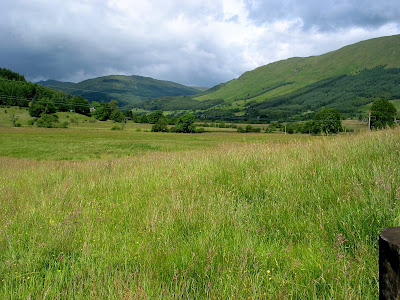
Anyway, we liked it so much, we left it in place. We were seeing photographs we hadn't seen in years. "Hey, look at that!" "Hey!" One of the photos that flashed by a little while ago was from our genealogy trip a year and a half ago to England, Wales and Scotland. the photo was of a field in the Trossachs in Scotland and it struck me how lucky we were to have gotten to see it. We saw wonderful things at every turn on that trip, but this field really stuck with me. We were driving through the area on a day trip and there was one spot where a car could pull off so I stopped to take a photograph.
There was a little pathway that led through the bushes by the road to a hidden field beyond. So we had to go through. It wasn't a cultivated field, although it probably was at one time or another. With so much history, you can't escape reuse. But it was just grass now and you could hear the loch beyond. There was no one around, no buildings in sight and traffic noise had faded away. It could have been any time in the last four thousand years. No one was taking care of this place, it was just growing this way, just as you've read about it a hundred times and there we were!


 And then we drove to the hometown of Rob Roy (Robert MacGregor) in Balquhidder Parish to visit the cemetery and say hello
.
 Here's what's left of his old church.
 I don't know if you can read the inscription there, but it says MacGregor Despite Them. If you click on the photograph, it will enlarge. Boy, if that isn't Scotland!
 Scotland has a motto "Nemo Me Impume Lacessit" which means literally "No One Assails Me with Impunity" but the modern colloquial translation is closer to "Don't F*** With Me".
Believe it!
How's that for a title? I wrote earlier that English is such a rich, variable language that people can still write a sentence today that NO ONE may have every written before. Like this title for instance. What it means is that I'm going to show you some more photographs of matching locations separated by sixty years or so.
But first a bit of history. Back just after the Civil War, in the days of Fort Dallas (before there was a 'Miami', Florida) Dade County was pretty quiet except for the Indians. Along the stretch of Biscayne Bay coastline from NE 80th Street to 95th Street was a settlement named Biscayne and for quite a while it was the county seat for Dade County. The post office, court house, etc. were all there. Now it's all gone, any remnants are under the houses of Miami Shores. Military Highway ran right through town on what is now NE 10th Avenue. In later years, that would be East Dixie Highway. The only commemoration left is a small park (a park-let really) with a plaque and some benches. That's a little sad, but time passes, you know? Here's what the park looks like now. Here's my wife, Deb, sinking into the luxurious grass.
 When we were there in 2002, I had no idea that I had been there before, but my Sherlock Holmes-like detective work has proven otherwise.Here's a set of photographs taken by my mother of my father and brother in this park. Sure, there were changes, but once I figured out where to look, it all became very clear. I must say, it was very satisfying to figure out these locations.


 Sherlock Holmes, my foot.


 Posts
Posts


 My hobby is genealogy and as a result, I know something about my ancestors. Most lines, excluding the presidents and governors and such were just good solid farming stock. They worked hard, they had no Social Security and they lived a gooood long time. Many lived into their upper nineties. Shown here is Nimrod Harrison, Jr. and his wife Sarah C. Watkins Harrison, my great grandfather and great grandmother. In this photo in 1910, he was 71 and she was 65. He lived on for another ten years and she for twenty. And they were the slackers of the family fading away so young.
 On my mother's side, outside of one German line, all of her folks came from Posen, Poland. Here's my grandfather Roman Damos Pawlak and grandmother Wanda Marie Pokornoski Pawlak in 1963 when he was 82 and she was 76. They still worked their dairy farm right up until the end. The man standing behind them is my uncle Edwin Pawlak, I've written about him in this blog before. My point in all this is to discuss how long I'm going to be writing this thing. I'm sure you'll be sick and tired of it if you aren't already.
 My mother grew up during the Depression, you know, the other really bad one. And her family was poor enough already, I bet the Depression didn't help any. I can clearly remember her swiping sugar packets if we were ever in a place that had them. I guess folks had to do that if they were going to survive. But my lines DID survive, lousy healthcare, no healthcare, whatever - they had the ability to survive. And part of that, at least, can be attributed to good genes. Good strong, Depression-era-fighting genes.
 So once again, my blood sugar was fine, pulse 58, BP 120/82. The Nurse asked me if I had any stress in my job. OOOh NOoooo. Apparently if I didn't have the stress, I'd die of low blood pressure. The real killer, of course, is cholesterol. Mine continued it's decline and is now 148.
 But that doesn't tell the whole story because my HDL, the 'good' cholesterol, is very high, out of the normal range leaving me with very low LDL (the 'bad' cholesterol). So the Nurse checked my carotid arteries to discover if they were open or not (they were), gave me a box of Krispy Kreme glazed doughnuts and sent me on my way to the next spot.
 They told me my skin is bad. I know my skin is bad. I spent too much time in the sun in Miami and I'm sorry. Every time I see someone at work come in after too much sun exposure, I just want to slap some sense into them. You can't take the damage back. There it is to stare you in the face forever.